Parish Information
History Group
Join the Hinton St George History Group for regular presentations by guest speakers and occasional history exhibitions in the village.
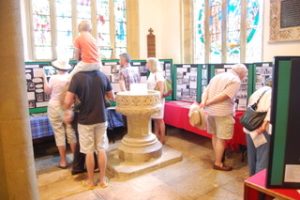
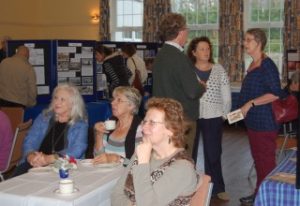
In 2014 some villagers with an interest in local history curated an exhibition, which included over 20 display boards, 300 old photographs, an illustrated timeline together with relevant books and facsimiles of important documents. The project also included recorded memories of a number of long term residents.
We would like to thank Rupert Lewin in giving open access to his extensive village history archive. Much of the content of the exhibition is being transcribed onto the church touchscreen as an ongoing project.
The original project has developed into the Hinton St George History Group, which is an informal organisation presenting spring and autumn history presentations by outside speakers and occasional history exhibitions in the village.
If you are interested in helping the group or are able to provide historic information please contact Heather Morecombe. Call 07968083489 or email: morecombes@gmail.com
Date for Your Diary – Spitfire Girl, my life in the sky, 7.30pm Friday 9th Oct 2026 at St Georges Hall
Candy Adkins will relate the inspirational story of her mother, Jackie Adkins, who was a pioneer for women in aviation. Discover how she played a pivotal role in the war effort, flying planes to where they were needed, even as far as Burma, with only a map and compass. Jackie finally earned her full RAF wings and a King’s commendation in 1953.
Advance tickets £6 from Our Shop or £7 on the door. Doors open 7pm, pay bar, cash only.
HMS Victory – Clive Thorne
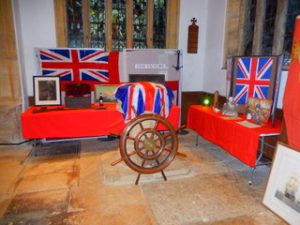
For our first presentation on Saturday 25th November 2017 in St. George’s Church we were treated to a fascinating talk by Clive Thorne, a local resident and trustee of HMS Victory, who was piped ‘aboard’ by Nigel Hayler on his Bosun’s Call. Clive’s excellent talk gave an insight into the events surrounding the Battle of Trafalgar and the challenges faced today in trying to preserve this, our most iconic warship, for posterity.
We were delighted that this first offering by Hinton History group was so well-supported and an excellent evening was enjoyed by all, no doubt aided by the complimentary Navy rum and ship’s biscuit.
An evocative atmosphere was created by soundtracks of creaking timbers and sea shanties with the church bedecked with flags and pennants. Numerous naval artefacts, loaned by Hinton residents, made a very interesting display which was much appreciated before the talk and during the interval.
We would like to thank all those (too numerous to mention here) who helped to make this a most successful evening.
What have the Roman’s ever done for Hinton? – John Smith
On Friday 9th November 2018, on one of the most inclement nights of the year, battered by high winds and torrential rain, we were treated to an exceptional talk by John Smith, archaeologist and historian, on the Roman Army in Somerset.
He brought history to life with his collection of replica clothing, armour and weapons and, demonstrating his vast knowledge and understanding of the era with subtle humour, he also managed to debunk a few myths along the way.
We are very grateful to John and his wife for making the journey from Wiltshire in such weather, even managing to avoid a fallen tree on the A30 near West Coker. Thanks also to all in the audience for venturing out on such an awful night to join us.
Literary Somerset – James Crowden
On Friday 22nd February 2019 we were treated to an exploration of the literary heritage of our county, by James Crowden, celebrated author and poet. He drew upon the lives and works of poets, novelists, travel writers and explorers, scientists, philosophers, clerics, historians and playwrights, all of whom had a connection with Somerset.
We were taken on a literary journey from the anonymous writer of the earliest poem in the English language, through the medieval period and Chaucer, to novel pioneers Daniel Defoe, Henry and Sarah Fielding, to romantic poet Samuel Taylor Coleridge, to pirate and explorer, William Dampier, who was born in East Coker and to T. S. Eliot who was interred there.
Well-deserving of their mention among these illustrious writers was Henry Fowler, lexicographer, who lived at Gainsfords (formerly Sunnyside) in Hinton and our very own Hugh Leach, ex-soldier, diplomat and travel writer who lived in Hinton from 1995.
After the interval James concentrated on Somerset war poets and in particular a World War Two poet of the Western Desert, John Jarmain; he read Mathematics at Cambridge, taught at Millfield, and served as an officer in the 51st Highland Division’s anti-tank unit seeing action at El Alamein and Tripoli. He was killed in action near Caen after the D-Day landings in Normandy. He is considered to be one of the truly great but neglected poets of the Second World War so we were pleased to have been made aware of his work by James.
Once again our thanks go to James Crowden for sharing his insights, research and encyclopaedic knowledge with us.
The Mapping of Somerset – Joe and Christine King
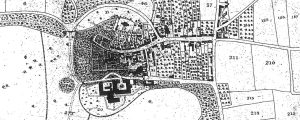
On Friday 25th October 2019 at St George’s Hall a large audience enjoyed an excellent talk, ‘The Mapping of Somerset’ by Joe and Christine King. Over the past 25 years Joe and Christine have amassed an impressive collection of historical maps of Somerset dating from the 16th to the 20th Century. The talk was illustrated by high quality slides of many of the maps in their collection, starting with the famous Saxton map of 1575. Of particular interest were enlarged sections of the maps of the Hinton area revealing more detail which stimulated interesting contributions from the audience. I am pleased to say that these enlarged sections will soon be on view in the Village History section of the church touch screen. In addition to the presentation a large number of interesting maps were available for the audience to browse before and after the presentation – rounding off a fascinating evening.
Rich man, poor man, beggar man, thief – scrambling up the family tree – Robert Ward
On Friday 31st January 2020 we had our first meeting of the New Year when Robert Ward, writer for “Who do you think you are”? magazine, gave an outstanding talk on ancestry entitled “Rich man, poor man, beggar man, thief – scrambling up the family tree”. Through his excellent power point presentation we embarked on an amazing journey tracing back his family history all the way to before the Norman Conquest. The truly incredible number of sources used helped to unearth fascinating characters and long-forgotten interesting historical facts. It is no exaggeration to say that we were all in awe of his achievement.
So, grateful thanks to Robert for entertaining us and for giving us an insight into how to approach researching your own family tree.
The Battle of Britain over Somerset – John Smith
An audience of forty attended the Hinton St George History Group meeting on 8th October 2021 in St George’s Hall, which was the first since January 2020. We were delighted to welcome back John Smith for his talk on The Battle of Britain over Somerset, which, due to Covid, had been postponed from the 80th anniversary in October last year. Armed with a vast array of British and German model aircraft and an encyclopaedic knowledge of the battle he took his spellbound audience through the dramatic events of 1940, with particular emphasis on Somerset and the West Country. A fascinating talk expertly delivered with no notes. Many thanks to him and all who supported this event.
Coffers, clysters, comfrey and coifs – Janet Few
Over 30 people attended the Hinton St. George History group talk on Friday 4th February 2022 in St. George’s Hall where we were delighted to welcome Dr. Janet Few, social and family historian, author and lecturer.
Janet, or should we say her alter-ego Mistress Agnes, ably assisted by her partner Master Christopher, kept us entertained in this enjoyable, illustrated talk on the domestic lives of ordinary folk in 17th century. Both were dressed in period costume and there was audience participation when a willing volunteer was asked to don 17th century garments to illustrate women’s clothing. This included a linen shift, petticoat, laced bodice, linen collar, coif and bum-roll!
The talk was full of fascinating detail about housing, cooking, cleaning, clothing, use of herbs, medicines, illnesses and cures and much, much more.
We also learnt the meanings and origin of certain modern-day phrases such as straight-laced, upper-crust, threshold, rue the day, keeping something at bay to name but a few.
Neither do we think anyone will forget the rather daunting piece of medical equipment called a “clyster” – the least said about its use, the better! Or the content of toothpaste which contained ground rats’ skulls, lavender and urine applied with the finger. In fact we learnt that there were lots of uses for urine in 17th century – it seemed to be the go-to ingredient if all else failed!
We were impressed by Dr Few’s encyclopaedic knowledge of the period, delivered without notes – a memorable talk for which we thank her and partner Chris.
And many thanks also to all those who supported this event and for being willing to wear face coverings and put up with the door and the windows open!
Somerset Crafts – Kate Lynch
We were delighted to welcome our speaker, Somerset artist Kate Lynch on Friday 21st October 2022. Kate gave a fascinating talk, peppered with anecdotes which revealed her love of traditional Somerset crafts. Kate’s talk was illustrated with some of her dynamic paintings and drawings of traditional craftspeople at work, including a brush maker, thatcher, basket maker, farrier and bell rope maker. It was good to hear that these crafts are still being practiced today and celebrated in Kate’s latest book ‘Craft’.
The German Occupation of the Channel Islands in WW2 – James Porter
On Friday 10th Feb 2023 in St George’s Hall, a record audience of over 60 enjoyed an illustrated talk by Lieutenant Colonel James Porter exploring the events leading up to the occupation in 1940 after the fall of France, the evacuation of part of the population, the arrival of the German forces, their reception and their everyday life in the islands. He examined the changing relations between the occupying forces and island authorities and the massive construction programme of fortifications. He also looked at the British commando raids and the life and privations of the civilian population as the War progressed and food became increasingly scarce for both islanders and occupiers.
Shrewsbury Flax Mill – ‘The most important building of the Modern Age’ – Alastair Godfrey
On Friday 20th October 2023 in St George’s Hall new Hinton resident Alastair Godfrey from Historic England gave a fascinating presentation on the Shrewsbury Flax Mill Restoration Project for which he is project manager. An audience of 50 were enthralled by Alastair’s enthusiastic description of the history and restoration of the Mill and associated buildings.
The 5 storey Mill was built in 1797 with a cast iron frame to create a fireproof structure. More importantly, the strength that iron gave to the Mill was the leap forward needed to allow buildings to be built taller. Now described as the grandparent of the modern skyscraper, the Mill is the first known multi-storey cast iron-framed building in the world and is of international significance.
The on-going restoration project was started in 2014 and was assisted by a multi-million pound grant from The National Heritage Lottery Fund.
All profits from the presentation were donated to the Hinton Church Bells Appeal.
Digging up Hinton History – Emily Chambers
Our speaker, local detectorist Emily Chambers, treated us to an excellent illustrated talk on Friday 8th March 2024 in St George’s Hall entitled ‘Digging up Hinton History’ about her discoveries in the Hinton area. Emily talked us through some of her favourite finds in chronological order, from the Iron Age, Saxons and Romans through to the Victorians and the 20th Century. Memorable examples included Iron Age hammer heads, decorated Roman pins, a mediaeval thimble, numerous coins including a gold Henry VII half Angel, a Georgian toy canon (which would have been fired with gunpowder!) and a 1930s lead motorbike. Numerous items were also on display and attracted a lot of attention at the end of the talk. With her enthusiastic and knowledgeable presentation, photos and impressive collection, Emily kept us spellbound and brought history to life.
A Victorian Head Gardener – Francis Burroughs
On Friday 11th October 2024 we were treated to an amusing and very informative talk on the life of Dr Francis Burroughes’ father who began his horticultural career as a gardener’s boy at the age of twelve, working from 6.30 in the morning until sunset every weekday and until 5pm Saturdays.
We learnt about the fascinating life of the Victorian country estate, a way of life now entirely vanished – the sheer number of staff employed and the extraordinary lengths they went to so they could have immaculate lawns, flower beds, cutting gardens, vegetables, pineapples in glasshouses and grapes available for ten months of the year.
Imagine mowing the lawns with a horse-drawn mower and with no grass box to collect the clippings. It needed two horses for this task plus grooms, under-gardeners, boys etc. a total of seventeen in all. And the horse had to wear leather boots, of course!
We discovered why the butler served a single pear on a silver tray to his Lordship and it had to be picked and eaten within a half hour.
We learnt that trailing hothouse plants were grown specially to decorate dinner tables with elaborate centrepieces such as water features complete with statue and fountain!
Life changed after WW1 when growing orchids and salad crops become popular. Herbaceous borders and alpine gardens began to replace the “carpet bedding” of the Victorian period.
Francis’s father moved various times in his long career to gain experience in these new aspects of his trade eventually securing a post as Head Gardener and later owning his own nursery.
An entertaining and intriguing talk which was humorous and well-delivered. It was much enjoyed and appreciated by all present.
Sound Your Instruments of Joy, Outdoor Music and Celebratory Sound – Tim Hill
On Friday 28th March 2025 Somerset musician, performer and musical director Tim Hill gave an unusual and lively presentation, which drew on Somerset and the West Country’s rich history of outdoor music and explored the social history and role of music and sound making, especially at key times of the year and in parades, processions, fairs and dances. The music ranged from ancient horns to village bands, folk noise, militia bands, drummers, rough music, Friendly Society marches, civic parades, wassails and much more. The talk included Tim singing and playing musical instruments together with many photos and pictures he had gathered over the years.
After the Romans – C5 to C11 – Denny Robbins
A packed hall really enjoyed this wide-ranging talk on Friday 10th October 2025 by Denny Robbins, some in the audience took screen shots and one even made notes!
We discovered how recent advances in archaeology, dendrology, radiocarbon dating, geophysics etc. have unlocked some of the mysteries of this rather “opaque” period.
We covered early migration, settlement, the Saxon kingdoms, particularly Wessex and its Royal House, laws and justice, villages and agriculture, place names and the role of women including the freedoms that upper class women enjoyed.
Facts emerged about the effects of climate, sickness and natural disasters – for example, the year of “no sun” from 535 CE where a volcanic eruption led to crop failure and starvation. Plague was also a frequent visitor with 25% or more of the population dying during the so-called Justinian Plague from 541CE.
Denny also touched on Saxon kings Ine and Alfred, The Crewkerne Hundred, Hinton St. George’s Street pattern and The Domesday Book entry for the village.
Our thanks go to Denny and husband Mike, those who helped clear away at the end of the talk and to Richard who had to forgo his pint in The Lord Poulett to assist with a technical issue!
Hand in Glove – Joseph Lewis
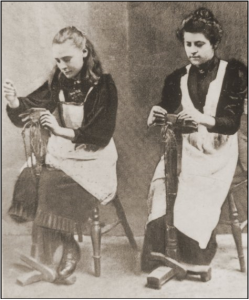
On Friday 27th March we enjoyed a talk by Somerset Heritage Co-ordinator, Joseph Lewis. Why does Yeovil have a football team called The Glovers and what is a Gloving Donkey? We discovered the answers to these questions and more when Joseph described the growth of the leather dressing and gloving industry in Yeovil and South Somerset; from cottage industries in outlying villages like Hinton St George* to the industry based in Yeovil, which at its peak, was producing half the leather gloves in England! Joseph explored the contribution of well- known names such as Clothier, Giles & Co and Ewens & Johnson as well as the outlying villages. The evening was enhanced by contributions from members of the audience whose relatives were directly involved in the industry.
*During the mid-19th Century, 44 women and girls in Hinton St George were taking in gloving, a common occupation for the poor of the area.